Website Structure: A Simple and Complete Guide
Learn what website structure is and how to organize your website for easy navigation and better search visibility using simple, clear steps.
5 minutes read
Learn what website structure is and how to organize your website for easy navigation and better search visibility using simple, clear steps.
5 minutes read
Author:
Anjum Ali
Updated:
February 11, 2026
Website Structure means how your website pages are organized and interlinked. A good structure can help visitors to find what they are looking for easily and can help search engines to better understand your website. If your site lacks any clear structure, then it will get confusing for the users and for the search engines as well.
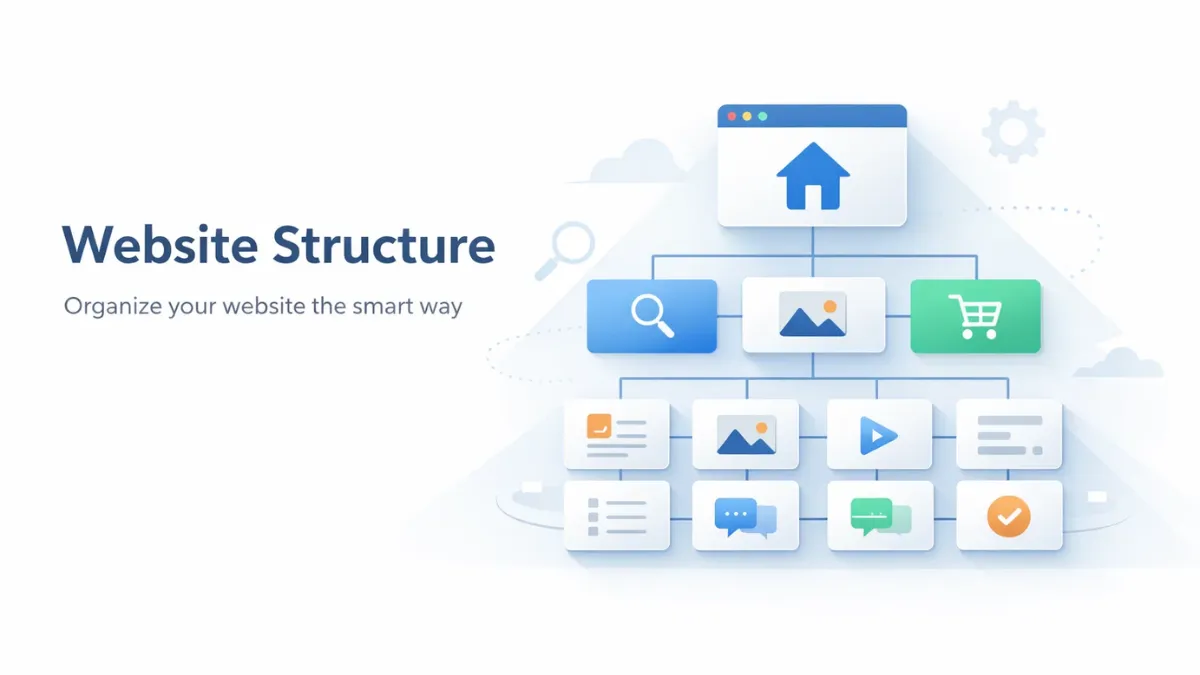
Website structure is an aspect of how your pages are structured. It helps to see what pages are important, but also how other pages are associated with these pages. Think of your website as if it is building, homepage is the entrance, categories are the floor and pages are the rooms.
A good website structure ensures that your website is easy to use. Visitors can also move from page to page without getting lost. Search engines will be able to read your website much easier and display your pages in searches as well.
When your site is well organized, people can quickly find what they are looking for. They linger longer on your web site, and are more likely to get in touch with you or purchase something. A clean structure also makes your web site look more professional.
Search engines use links to comprehend your website. If your pages are well connected, search engines know which are the most important pages. This can help your website to rank higher in search results.
A simple and strong site structure looks like a pyramid:
Your homepage is the main entrance to your website. It should be connected to your most important pages. Do not add too many links or visitors will become confused. Keep it clean and clear.
The menu helps users in moving around your web site. Your main categories should be in the menu. The menu must be simple and easy to read. Too many items in the menu can cause it to be difficult to use.
Breadcrumbs indicate to users where they are located on your website. So they appear as a path, such as: Home > Category > Page. They help the users to go back easily and understand the positioning of the page.
Categories assemble similar content together. For example, an online shop can have classifications such as shoes, shirts, and bags. Tags are used to describe small details of a page, such as color or brand. Categories represent major topics, and tags represent additional information.
Internal links are used to link one page of your website to another. They help users to read more content which is related to it. They also help search engines to understand your website better. Always link pages which are related to each other.
Some pages are more important than others. These pages should have more links to them. They should be able to explain a topic clearly and fully explain it. These pages help the visitor learn and help the search engines to trust your site.
These pages should be all about what you are offering. They should be brief, concise and useful. Don't send your visitors away with too many links. The main goal is to help them to make a decision.
Over time, websites develop and change. Old pages may become useless. You should be removing, or updating, old pages and linking them to new pages when necessary. This helps to keep your website fresh and useful.
If you create so many pages on the same subject, they may be competing with one another. It is preferable to put similar pages in a single strong page. This is what helps your website to perform better in search results.
A good site structure is good for users as well as search engines. It makes your website easy to use, easy to understand, easy to grow. By properly organizing your pages and linking them well, you are building a great foundation for your website.




No comments yet. Be the first to post!